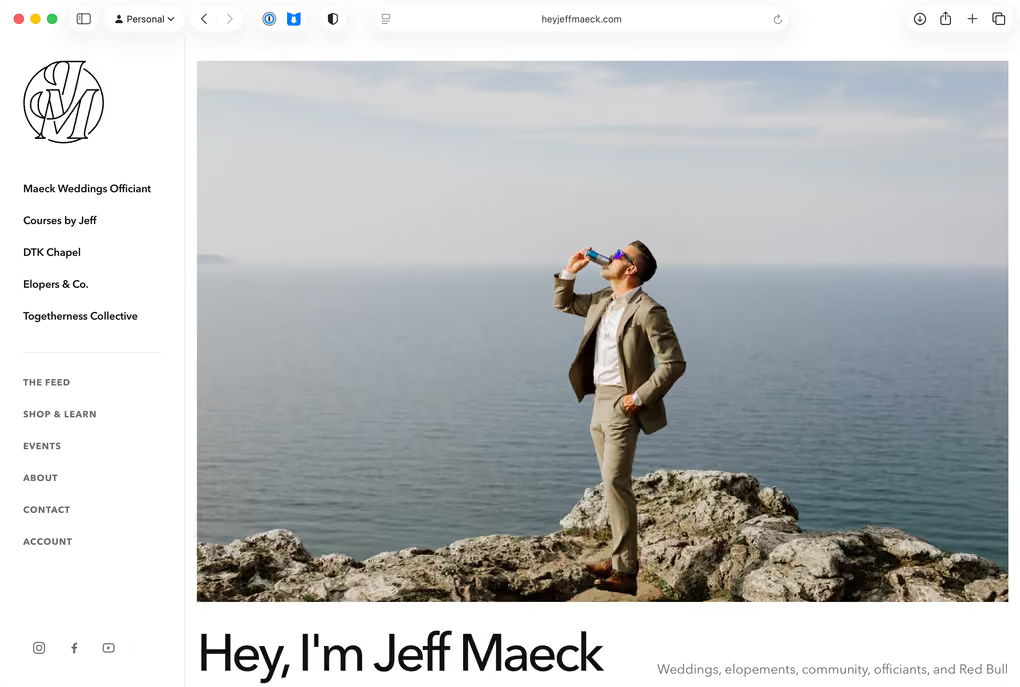
Jeff Maeck asked me to build him a new website because his personal brand had outgrown his old one.
The old site lived on Podia. It sold and delivered his course, which was the job Podia was built for, but the whole website was hitched to whatever the Podia editor and product model would allow. Jeff wanted to host events. His work had grown to include several connected brands, products, workshops and a growing body of useful content.
A site centred on the course was no longer enough.
I saw an opportunity to build the ultimate link in bio site: one ultra-fast website for all of Jeff’s brands, events, courses, products and content, owned by Jeff, with links to all of his businesses, brands, activities, and content. One URL to rule them all, one URL to find them, one URL to bring them all and in the dark mode, bind them.
The URL? heyjeffmaeck.com.
One Jeff
Jeff’s work spans officiating, Maeck Weddings, DTK Chapel, Elopers & Co., Togetherness Collective, courses and events.
Each project needs room to have its own identity, but a visitor should not need an organisational chart to work out how they relate to one another.
The homepage makes Jeff the common thread and gives people a clear path to the thing they came for. Someone who knows him as an officiant can find a workshop; someone who knows the chapel can find his writing or the next event.
A normal link-in-bio tool could list those URLs. I wanted Jeff’s own domain to explain how everything fit together, build his authority, sell tickets and courses, and give his content a proper home.
Professional without sanding Jeff off
Jeff takes his work seriously. He is also funny, particular and powered by a suspicious amount of Red Bull. The website needed to look professional without making him look like a stock photo wearing a suit.
Click Jeff’s name on the homepage and it answers a question. Scroll past the hero image and a parallax sequence shows him raising and drinking a Red Bull. On a desktop sized screen, his logo spins around and turns into his face when you hover over it. Find a broken URL (which would take you to the 404 error page) and you land on Flappy Jeff, a Red Bull-inspired 404 page game with touch, keyboard and pointer controls.
I love software Easter eggs, but also, the site never depends on them. The navigation remains ordinary HTML. The parallax scene has a still-image fallback. Reduced-motion settings are respected. You can miss every joke and still get a fast, clear business website; finding one makes the place feel more like Jeff.
The hard bit was making the site feel like Jeff without letting the jokes get in the way of the business.
Fast had to be part of the architecture
I built the public site with Astro because most of these pages do not need a browser to download and boot a large JavaScript application before it can show the words. Astro produces complete HTML ahead of time, and Cloudflare serves it close to the visitor.
A backend built around Jeff’s business
The public website is what visitors see. Behind it is a custom backend I built to directly serve Jeff’s business needs, with courses, customer accounts for re-access and download of products, event management and ticketing, digital downloads, email marketing, and publishing all managed from the same admin backend so Jeff doesn’t have to bother with multiple dashboards and editing Markdown files.
The course delivery that used to live in Podia now lives inside the Astro and Cloudflare site. The customer pays through Stripe, the backend grants the right access, and their account opens the course or download they bought. Cloudflare Stream serves the protected course videos, while Cloudflare R2 holds the private digital downloads. The same backend manages event capacity, issues individual tickets and check-in codes, and asks Resend to deliver receipts, reminders and marketing email.
Astro still builds the public content into static pages. When Jeff publishes through the admin, the backend commits the Markdown content and its images to GitHub in one revision. GitHub runs the validation and starts the deployment, Astro turns the Markdown into complete HTML, and Cloudflare serves the result. This gives Jeff a purpose-built CMS with the speed, portability and revision history of a static site.
That one backend replaces the Podia subscription, a Mailchimp subscription, a separate event-ticketing subscription, along with autmating the financials around all those situations. Jeff no longer needs all the disconnected dashboards to run the business, and the public website stays super fast.
A website people and machines can read
I also wanted the site ready for search engines and the answer engines people now use alongside them.
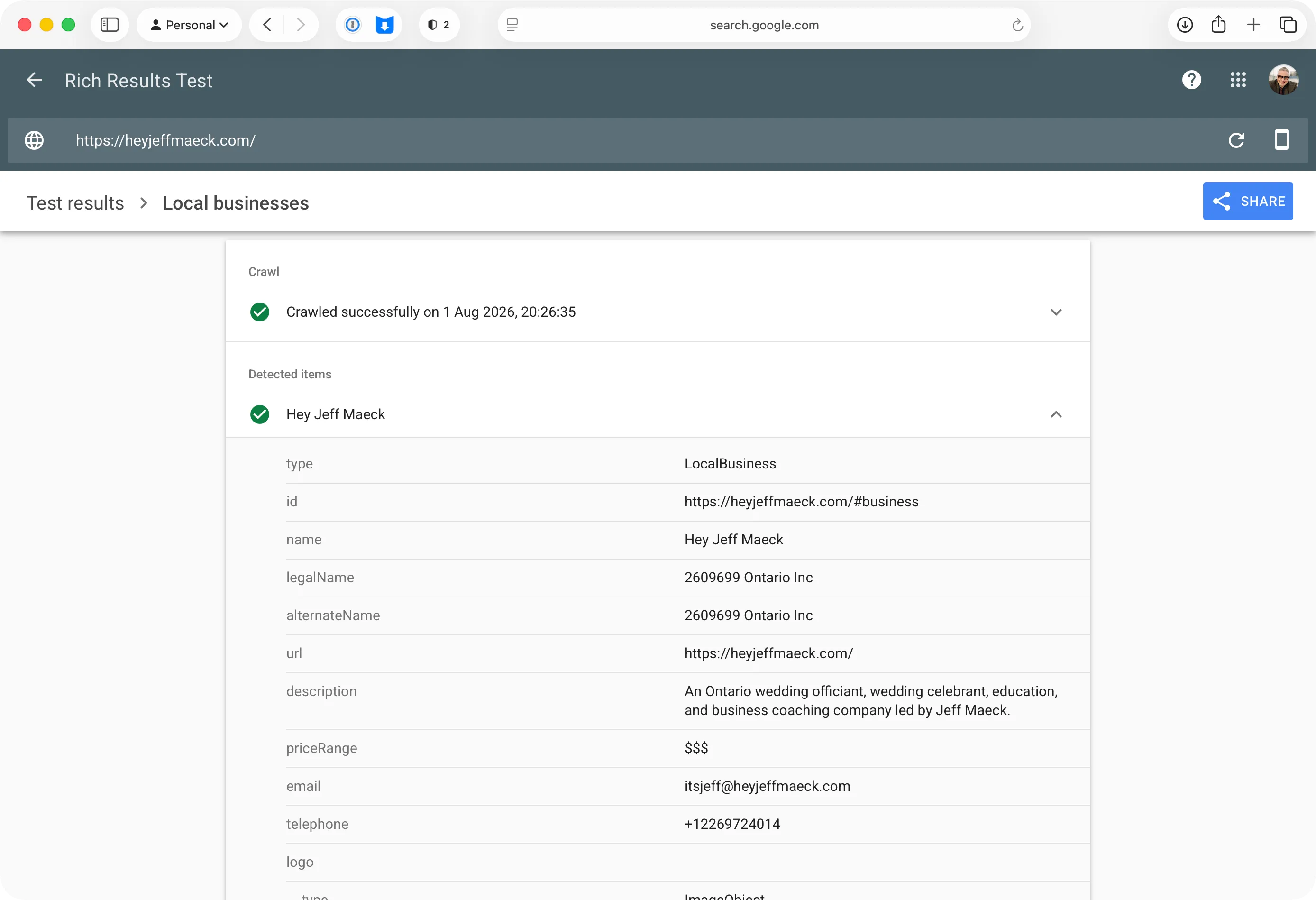
Every indexable public page in the sitemap has a clear title, description and canonical address. The site publishes an RSS feed, connects people, brands, services, products, events and articles through Schema.org data, and adds useful internal links between related work. The Google Rich Results Test crawled the homepage successfully and detected its LocalBusiness data when I captured this result on 1 August 2026.
Every public page intended for discovery also has a plain Markdown companion. The site publishes llms.txt and llms-full.txt. An AI assistant can retrieve a clean first-party version of a page without trying to extract the useful sentence from the navigation and visual layout.
GEO, or generative engine optimisation, still starts with good publishing: clear names, stable URLs, specific facts, visible text and honest relationships between things. The machine-readable versions come from the same validated content as the pages people see, which not only keeps them from drifting apart, but also increases the trust in the content from an algortihmic point of view.
Then I tested the lot
Before handover I ran the site through its internal validation suite, including the public pages and the business logic behind authentication, payments, tickets and email.
I’ve linked the external checks so you can run them yourself: Google Rich Results Test and Schema.org Markup Validator for structured data; Is Your Site Agent-Ready? for agent discovery; PageSpeed Insights for performance and page quality; W3C HTML Checker for the generated markup; and W3C Feed Validation Service for the RSS feed.
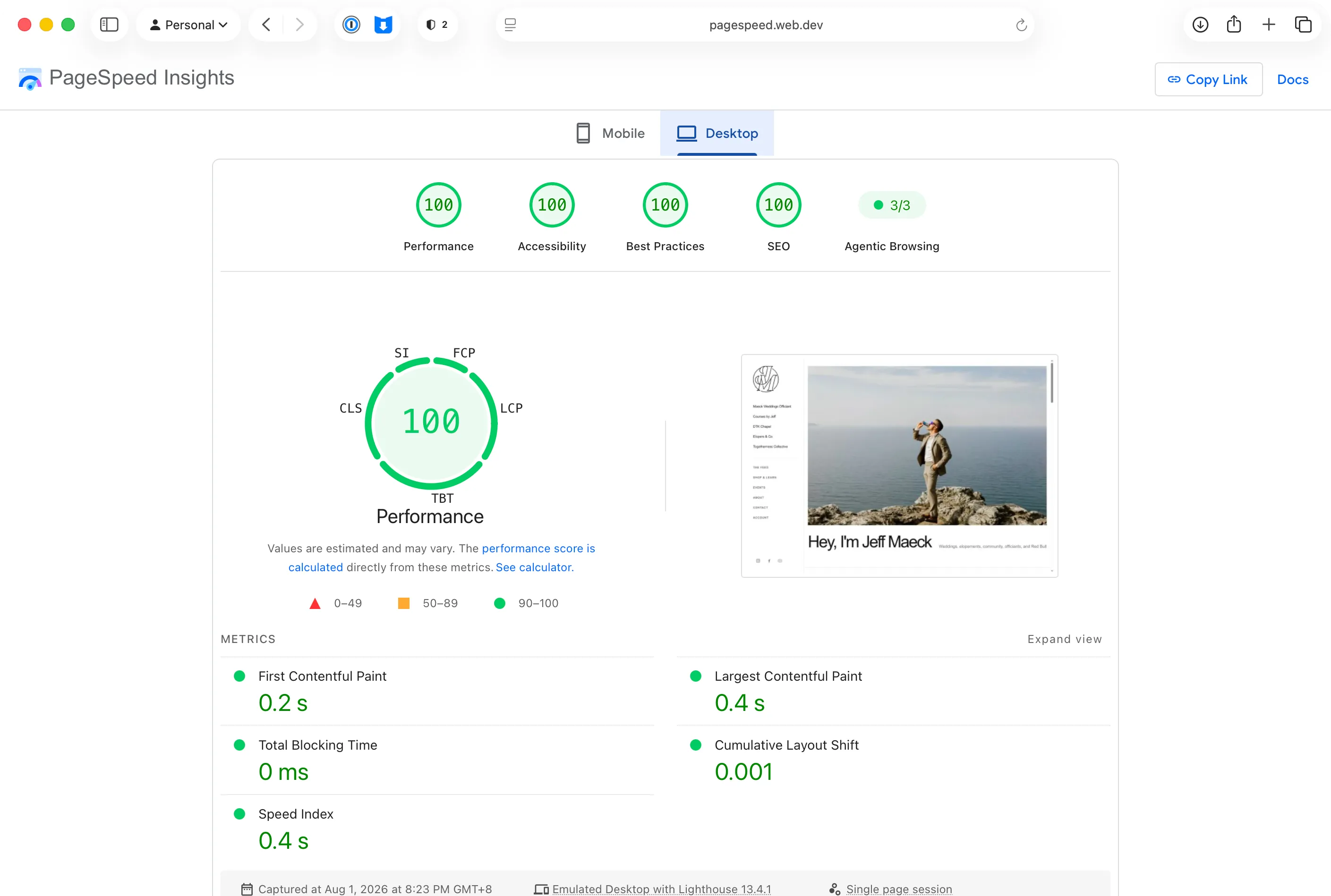
When I captured the PageSpeed Insights desktop report on 1 August 2026, the homepage returned 100 for performance, accessibility, best practices and SEO, plus 3/3 for agentic browsing.
At one handover checkpoint, the official Lighthouse CI run recorded 100/100 for performance, accessibility, best practices and SEO across three runs of four representative pages. The complete internal validation suite also passed, covering links, metadata, feeds, schema and machine-readable exports.
The scores do not measure taste. They tell me the site kept its speed and reliability after I added all the fun stuff.
Astro and Cloudflare gave me the speed and flexibility. My job was to bring Jeff’s complicated body of work into one place without making the website feel complicated or boring.
Jeff’s new site feels professional, a little strange and unmistakably Jeff.
I’m really proud of it.