Recently I registered an expired domain name that had belonged to someone I understood to have left the wedding industry. I was mistaken about that last part, which I only learned after the registration was complete.
The experience prompted some interesting conversations—some of them heated—about how domain names work, why people register expired ones, and what anyone running a business should know about protecting their online presence.
I’m not writing this to argue that I did nothing wrong. An apology was absolutely due, and I gave one. But I am writing it to explain myself—to share what I was thinking, why I did what I did, and what I’ve learned about how easily these situations can arise.
This article covers the SEO reasons behind expired domain registration, the Australian rules that govern it, and practical steps to make sure your domain never becomes someone else’s opportunity.
Why people register expired domains
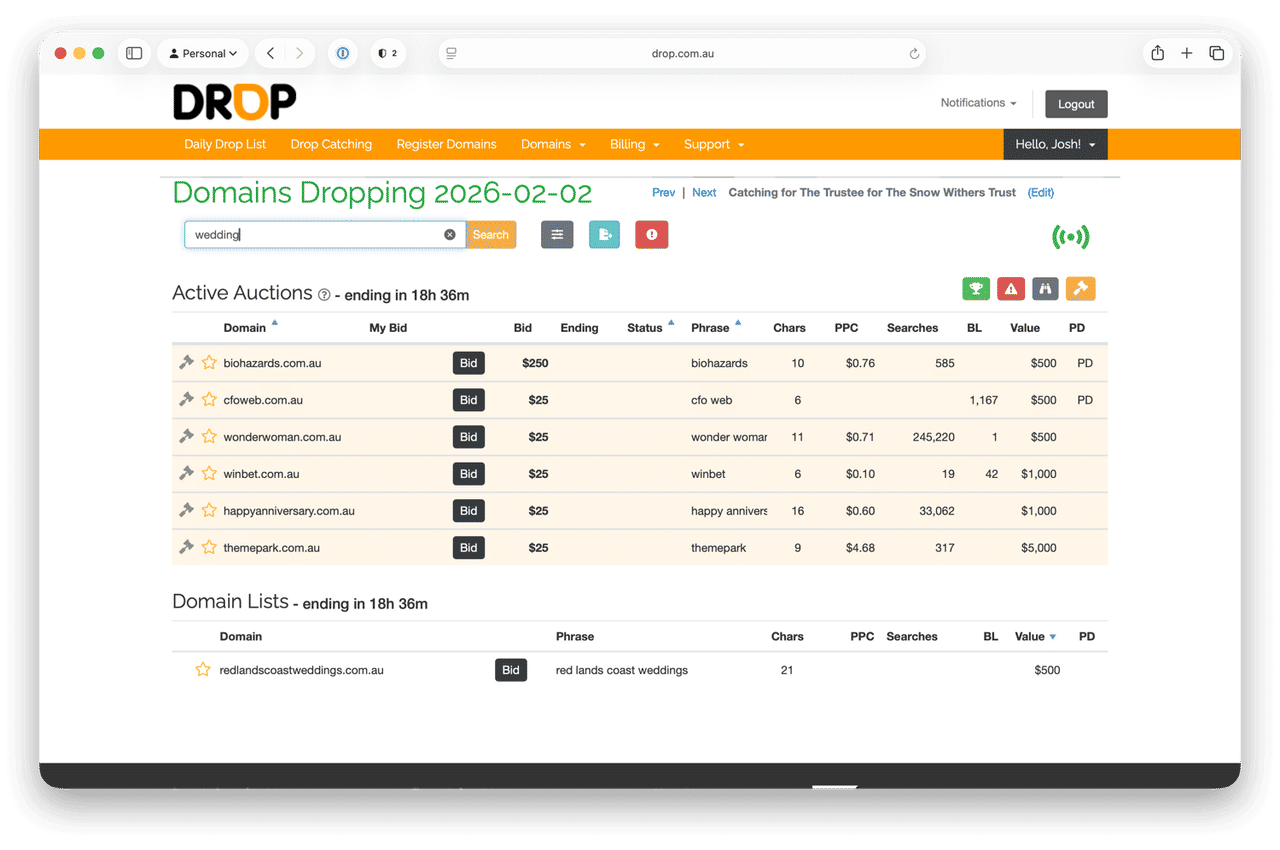
I use services like drop.com.au and expireddomains.net to monitor keywords relevant to my business. These tools track domains as they move through the expiry cycle and alert you when they become available.
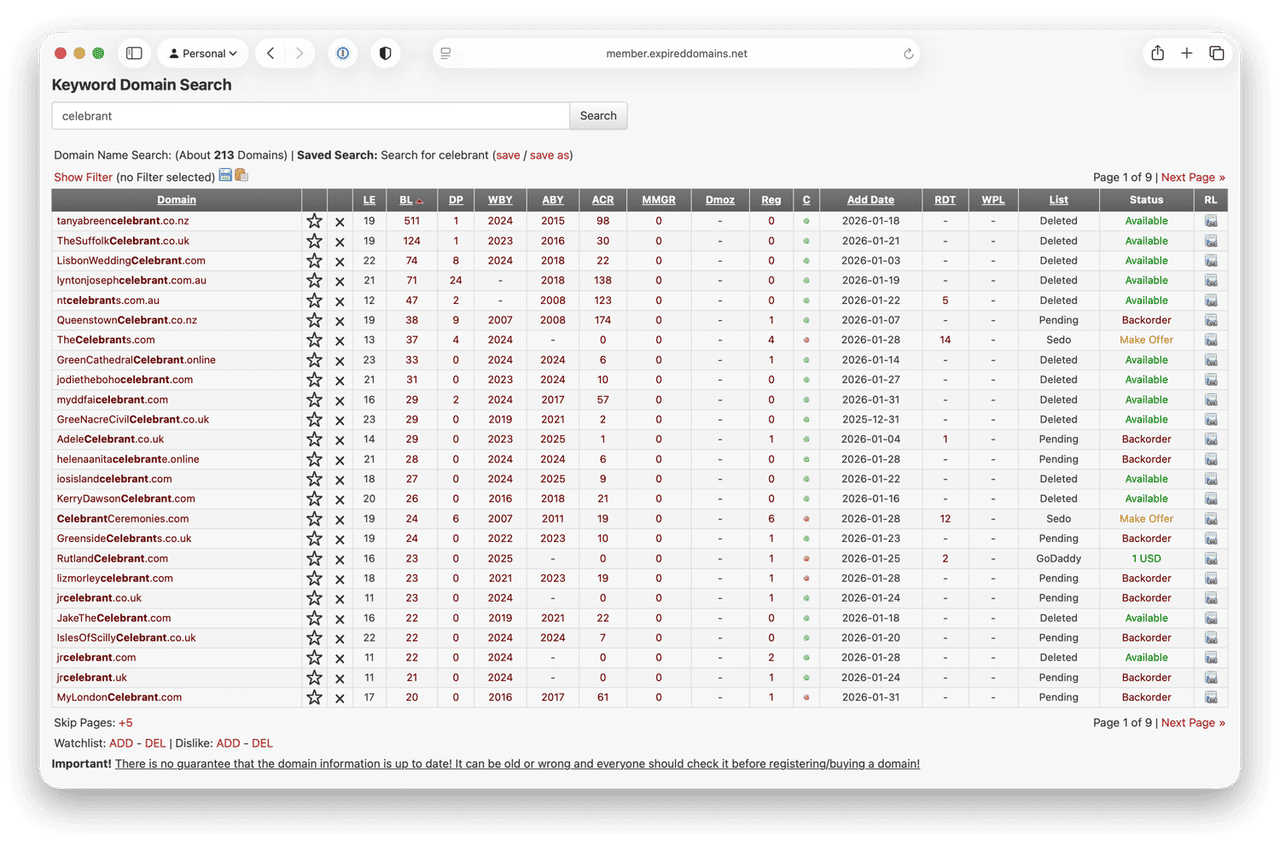
This might sound opportunistic if you’ve never encountered it before. But expired domain registration is a well-established practice with an entire industry built around it.
It’s standard practice in SEO
There’s nothing underground about registering expired domains. It’s a cornerstone of the search engine optimisation industry, with dedicated tools, marketplaces, and services supporting it.
The major SEO platforms—Ahrefs, SEMrush, Moz, and Majestic—all include features specifically for analysing expired domains. Dedicated tools like SpamZilla exist solely for finding expired domains with SEO value. Marketplaces like GoDaddy Auctions, and Sedo facilitate millions of dollars in expired domain transactions annually.
Domain investors, SEO professionals, web developers, and businesses of all sizes use expired domains as part of their digital strategy. Detailed.com’s case study documents how redirecting expired domains is a common strategy for building authority. NameSilo’s guide describes it as “one of the most underappreciated yet valuable resources” in SEO. DomCop’s evaluation guide walks through the multi-step process professionals use to assess expired domains.
This has been happening since the early days of the internet. It’s not a loophole or a grey area—it’s how the domain system was designed to work.
What is SEO? SEO stands for search engine optimisation—the practice of improving a website’s visibility in Google and other search engines. When someone searches “wedding celebrant Melbourne” or “elopement photographer Tasmania,” the results they see aren’t random. Google ranks websites based on hundreds of factors: how relevant the content is, how fast the site loads, how many other websites link to it, and how long the domain has been around. SEO is the work of improving those factors so your website appears higher in results.
Search engines have long memories
When a domain expires, Google doesn’t instantly forget it exists. The search engine maintains records of a domain’s performance history, backlink relationships, and trust signals for months after expiration.
A domain that’s been online for years, accumulating links from other websites and building authority in its niche, carries that value forward—even after it changes hands.
Backlinks are expensive to build
If you’ve ever tried to get other websites to link to yours, you know it’s slow, difficult work. Some expired domains have backlinks from news sites, industry publications, government websites, or educational institutions. Building those links from scratch could take years and cost thousands of dollars in outreach, content creation, or PR.
Registering an expired domain with an existing backlink profile gives you a head start that a brand new domain simply can’t match.
The Australian rules
In Australia, .au domains are regulated by auDA (.au Domain Administration). Their rules are clear on how expiry works and who can register what.
First come, first served
auDA explicitly operates on a first come, first served basis. There’s no hierarchy of rights—having previously owned a domain doesn’t give you priority to re-register it once it’s released.
This is stated directly in auDA’s eligibility and allocation policies. Previous ownership confers no special claim.
The expiry timeline
Here’s what happens when an Australian domain isn’t renewed:
-
At the exact expiry date: The domain enters “Expired Hold” status. It stops working (removed from DNS), but can still be renewed by the original owner.
-
30 days after expiry: The domain moves to “Expired Pending Purge” status and gets published on auDA’s Official Domain Drop List. At this point, the original owner can no longer renew it.
-
1 day after Pending Purge: The domain is purged from the registry and becomes available for anyone to register.
The purge cycles run daily at 1:00pm AEST for deleted domains and 1:30pm AEST for expired domains. Services like drop.com.au monitor these lists and can attempt to register domains the moment they become available.
You can read the full details in auDA’s Domain Renewal, Expiry and Deletion Policy.
Eligibility still applies
To register a .com.au or .net.au domain, you still need:
- An Australian presence (ABN, registered company, etc.)
- A legitimate connection to the domain name—either a match to your business name, trademark, or related to goods and services you provide
But once a domain is released, it’s available to anyone who meets these criteria. The previous owner has no more claim to it than anyone else.
This isn’t cybersquatting
Cybersquatting has a specific legal meaning. It requires bad faith—registering a domain specifically to sell it back to the “rightful” owner at an inflated price, or to disrupt a competitor’s business.
Registering an available domain for legitimate business use isn’t cybersquatting. It’s explicitly permitted under auDA’s licensing rules, which even include provisions for domain registration for “monetisation” purposes, provided the content relates to the domain name.
If someone believes a domain was registered in bad faith, they can lodge a complaint through auDA’s dispute resolution process or the .au Dispute Resolution Policy (auDRP). But the bar is high: you need to demonstrate the domain is identical or confusingly similar to a trademark you own, the registrant has no legitimate interest, and it was registered in bad faith.
What happened in my case
When I first noticed the domain was approaching expiry, I assumed the person had ceased operating in the wedding industry. Their website had been offline. The domain was clearly not being maintained.
I didn’t register it immediately. I waited two weeks to see if they would renew it. They didn’t. The domain completed its full expiry cycle—the 30-day grace period, the pending purge period—and was released by the registry system.
I registered it and set up a redirect for SEO purposes. That was the extent of my plan. I wasn’t trying to impersonate anyone, steal clients, or cause harm. I genuinely believed the domain had been abandoned by someone who had moved on from the industry.
It took almost three months for the previous owner to notice.
When they did, I learned I’d been wrong about them leaving the industry. That was my mistake—I’d made an assumption based on what I could see from the outside, and that assumption was incorrect.
I want to be clear: I’m not saying I did nothing wrong. Understanding someone else’s business situation from the outside is difficult, and I got it wrong. An apology was warranted, and I gave one. But I also didn’t “steal” anyone’s domain. I registered one that had been released after the previous owner didn’t renew it through the standard auDA process.
The purpose of this article isn’t to relitigate any of that. It’s to explain the context—why people register expired domains in the first place, how the system works, and what you can do to make sure this never happens to you.
How to protect your domain name
If you’re running a service business—as a celebrant, photographer, planner, or anything else—your domain name is one of your most important assets. Here’s how to make sure it stays yours.
Turn on auto-renewal
This is the single most important thing you can do. Most domain losses happen because someone forgot to renew, or their payment method failed.
Log into your registrar’s control panel and enable automatic renewal. Then check that your payment details are current. An expired credit card can cost you your domain.
Keep your contact details current
Registrars send renewal reminders by email—usually around 30 days and 7 days before expiry. If your email address is out of date, you won’t receive them.
Most registrars stopped sending postal mail years ago. If you’ve changed email addresses since you registered your domain, update your details now.
ICANN’s guidance emphasises that keeping contact information current is essential—it’s how you receive critical notifications about your domain.
Use a permanent email address
Don’t tie your domain management to an email that might change or expire. If you’re using a work email that depends on that same domain, you’ve created a circular problem—if the domain expires, you lose access to the email that would have warned you.
Use a personal Gmail, Outlook, or other permanent address for domain registration.
Register for multiple years
Instead of renewing annually, pay for 3-5 years upfront. It’s usually cheaper per year, and it dramatically reduces the chance of forgetting a renewal.
Some registrars also treat longer registrations as a minor positive signal for legitimacy.
Lock your domain
Most registrars offer a “registrar lock” feature that prevents your domain from being transferred without explicit approval. Turn it on. It adds a small hurdle if someone tries to gain control of your domain through social engineering or a compromised account.
Register variations
If your brand is valuable to you, consider registering the .com.au, .au, and .com versions of your domain. This prevents competitors or opportunists from picking up similar addresses and causing confusion.
It also protects you if one registration lapses—you’ve got backups.
Consider trademark registration
If your name genuinely is your brand, a registered trademark gives you legal options that domain registration alone doesn’t provide. It’s the strongest tool for dispute resolution if someone does register a domain you believe should be yours.
Trademark registration in Australia isn’t cheap (expect $250+ per class through IP Australia), and the process takes months. But for an established business, it’s worth considering.
What you can do if your domain expires
If you’ve missed the renewal window, act immediately:
-
Within 30 days of expiry: Contact your registrar. You can usually still renew, sometimes with an additional fee.
-
After 30 days: The domain enters Pending Purge and you lose the ability to renew. At this point, you’re racing against drop-catching services and anyone else monitoring the Official Domain Drop List.
-
After it’s released: The domain is available to anyone. You can try to register it yourself, but you’re competing with automated systems that can submit registrations within seconds of availability.
If someone else registers your expired domain, your options are limited:
-
auDA complaint: You can lodge a complaint if you believe the new registrant doesn’t meet eligibility requirements. But even if successful, this only results in the domain being cancelled—not transferred to you. You’d then need to register it yourself before someone else does.
-
auDRP dispute: This requires demonstrating trademark rights and bad faith. It costs $2,000-$4,500 depending on panel size, and the outcome isn’t guaranteed.
-
Court action: The most expensive option, and the only one that can award damages. Rarely worth it for a domain name unless significant money is at stake.
The honest reality: once your domain is gone, getting it back is difficult, expensive, and uncertain. Prevention is far easier than cure.
The bigger picture
Your domain name is a business asset. Treat it like one.
If you’re running a business, your domain is how customers find you, how your marketing connects, and often how your email works. Losing it means starting over—rebuilding your search presence, updating every piece of marketing material, and hoping your existing clients can still find you.
A few minutes setting up auto-renewal and verifying your contact details could save you months of damage control.
And if you’re leaving an industry? Consider what happens to your online presence. You can let your domain expire and accept that someone else might register it. You can redirect it somewhere useful. You can sell it. But know that once it’s released, it’s fair game.
Resources
Australian domain regulations:
- auDA Domain Renewal, Expiry and Deletion Policy
- auDA Licensing Rules
- auDA Eligibility and Allocation Policy
Domain protection guidance:
Expired domain SEO (industry context):
- Detailed.com: Expired Domain SEO Case Study
- NameSilo: The Hidden Value of Expired Domains
- DomCop: Buying Expired Domains Evaluation Guide
Tools I use:
- drop.com.au — Australian expired domain monitoring
- expireddomains.net — Global expired domain search