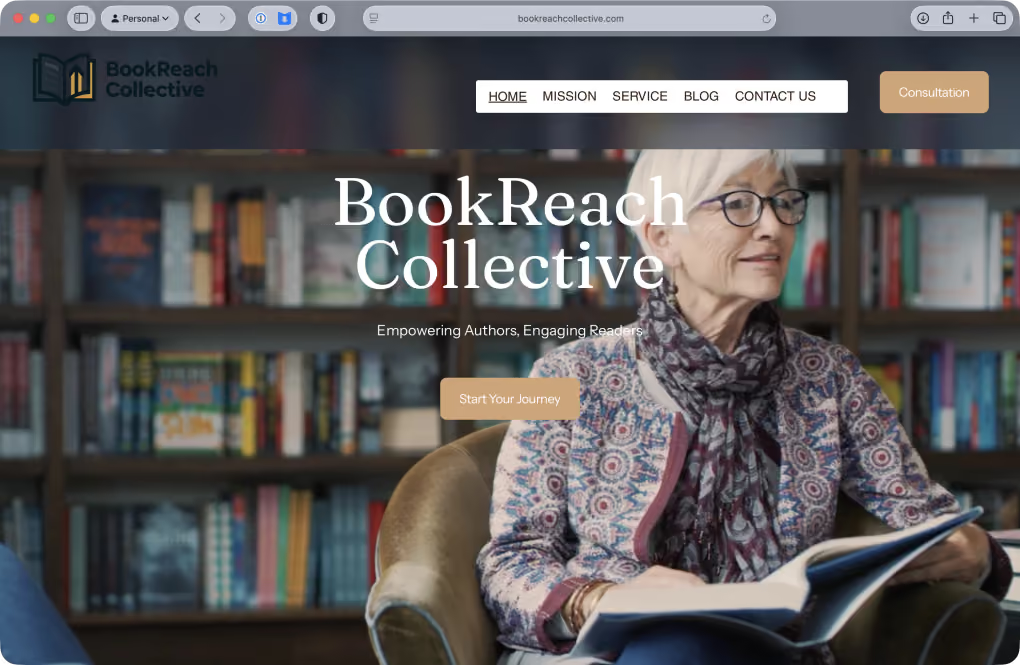
TLDR: I’ve got bad vibes over the BookReach Collective posing as Emily Winfield Martin and am warning authors about them.
Also, There seems to be a lot of companies trying to take advantage of people with something to write today, and in an age where writing words has never been easier, those that choose to do the hard work and use a keyboard to write all of their words instead of an LLM, should know that it’s actually not that hard to self publish, or even just write online.
Over the last few weeks, someone claiming to be a well-known children’s author emailed my uncle and praised his novel to build trust with him before recommending a book-marketing business. The available evidence strongly indicates that the person writing the emails is not Emily Winfield Martin, as the sender claims, and that instead the brand new book-marketing business is misrepresenting Emily in efforts to build its own business.
The book-marketing business, BookReach Collective, proposed a US$5,000 campaign beginning with a US$3,000 payment. BookReach may offer legitimate services; I cannot determine that from the information currently available. What the correspondence shows is that the sender claimed to be a well-published author while recommending BookReach, and that BookReach subsequently referred to “Emily” as “a valued member” and “one of our greatest authors.”
This article documents the representations made by the email account and BookReach, the evidence that contradicts or calls those representations into question, and the sequence that led to the US$5,000 proposal. I’m not suggesting that BookReach is breaking any laws, nor am I accusing them of wrongdoing. Just sharing the facts as we can see them.
Stage one: praise
On 28 July 2026, my uncle, Mark Rutherford, received an unsolicited email from the display name “Emily Winfield Author .Martins” using the free Gmail address of authoremilywinfield.martins@gmail.com. The message identified the sender as Emily Winfield Martin and linked to the real author’s website.
Note the additional “s” at the end of the surname in the display name, which changes Martin to Martins.
The email begins:
Dear Mark,
I hope you are well and that the writing life is treating you kindly at the moment.
Mark, I just finished reading Volcanic Winter, and I had to reach out. It is such a gripping, thought-provoking, and deeply unsettling thriller, and it stayed with me long after I turned the final page. I was particularly struck by how you take one of the most pressing issues of our time, climate change, and weave it into such a tense and morally complex political thriller.
Stage one was about building trust and a relationship.
Stage two: trust
My uncle was cautious, asking the sender to name the President’s Chief of Staff in Volcanic Winter. He intended to establish whether the sender was a bot, a scammer or a real person.
The reply answered correctly and went on to reinforce the sender’s credibility:
I have to say, I’m genuinely impressed by the question. It tells me you’re careful about who you engage with, and I respect that. Too many authors get burned by empty flattery from people who haven’t actually read the work.
Stage three: reassurance
After Mark expressed concern about AI-generated approaches, the sender wrote:
Thank you for such a generous and honest reply and please, don’t apologise for the scepticism. In this strange new world of AI-generated everything, I completely understand the need to filter. I promise I’m as human as they come (and I can prove it with a few clumsy typos if needed 😉). But I appreciate you giving me the chance to show I’m genuine, and I’m so glad we’re now having a real conversation.
The correspondence discussed Mark’s writing history, publishing frustrations, family and forthcoming manuscript, Unentitled. The sender praised its premise and asked about its state of editing and Mark’s publishing plans.
At one point, the account lied about writing a book:
I’ve written a few chapter books for older children, like The Girl Who Drew Butterflies (though that’s more a biography).
The Girl Who Drew Butterflies was written by Joyce Sidman, not Emily Winfield Martin. That is confirmed by the book’s bibliographic record. Emily Winfield Martin’s genuine bibliography is available through Penguin Random House.
The sender also offered signed books for Mark’s granddaughters:
And about your granddaughters I would be absolutely delighted to send them signed copies of The Wonderful Things You Will Be if you think they would enjoy it. Just let me know their names and where to send them. No charge, truly. It would be my pleasure to be part of their birthdays.
Stage four: the recommendation
After rapport had been established, the sender introduced BookReach Collective - bookreachcollective.com. This was framed not as a cold commercial pitch, but as a recommendation from one author to another:
What changed for me was finding an organisation that actually understood the indie author’s predicament. They helped me cut through the noise, reach the right readers, and build genuine buzz without me having to become a TikTok influencer (thank goodness). I honestly don’t think I would have seen the success I have without them.
I want to pass that same lifeline to you, because I think Unentitled deserves to be seen and read, and I know how draining it is to pour your heart into a book and then watch it sit there quietly.
The recommendation continued:
There’s a team called Book Reach Collective – they specialise in helping authors just like us. Their website is:
www.bookreachcollective.comAnd their email is:
hello@bookreachcollective.comWhat I’d suggest is filling out the consultation form on their website. Be upfront about your budget (even a modest one) and tell them exactly what you’re hoping to achieve whether it’s more reviews, newsletter features, social media promotions, or just getting Unentitled in front of the right audience. They’re very flexible.
Now, here’s the extra bit: they don’t accept every author they’re selective because they want to work with books they genuinely believe in. But I’m happy to reach out to them and let them know I’m recommending you. If I tell them you’re a friend of mine (which I genuinely hope we are becoming!), they’ll give your submission a proper look and likely fast-track it. They run promotions every month, and if you get in quickly, you might even catch this month’s campaign.
This combined an apparent endorsement from a successful author with exclusivity, friendship, a claimed fast track and time pressure connected to that month’s campaign.
When Mark raised concerns about cost and the Australian market, the sender replied:
First, let me put your mind at ease about Book Reach Collective. I have spoken with them directly and told them all about you and your work. They are genuinely interested and they said they will look at your project when you reach out. If they feel they can work with you, they will get back to you quickly. I have given them a strong recommendation because I truly believe in what you are doing, so I am confident they will give your submission proper attention.
Stage five: the request
Mark completed the BookReach consultation form. In its first email, BookReach wrote:
We appreciate you reaching out to us on the recommendation of a fellow author was that Emily, by any chance? She’s a valued member to us.
To help us better understand your project and how we can assist, could you please send us your completed manuscript for review? Once we receive it, one of our team members will carefully evaluate your work and get back to you with a thoughtful response within 24–48 hours.
Mark sent the manuscript. BookReach acknowledged receiving it and said its team was reviewing it.
The account claiming to be Emily then congratulated him:
That is brilliant news! I am so glad you went ahead and sent the manuscript through. And yes, I did get in touch with them before you I wanted to make sure they were keeping an eye out for your name. It sounds like they are already paying attention, which is exactly what we wanted.
I am really proud of you for taking that step.
Mark did not transfer any rights in the manuscript. To the best of our knowledge, it has not been published, distributed or otherwise misused.
Stage six: the US$5,000 proposal
BookReach returned with a plan covering Amazon optimisation, Goodreads management and pre-launch marketing. It wrote:
To be completely sincere with you, given the amount of work your project requires (Amazon full optimization, Goodreads management, and strategic prelaunch marketing), the actual market cost for these services would exceed the $5,000 USD budget you have in mind a little.
However, because you were referred by Emily who is one of our greatest authors and spoke incredibly highly of you we are happy to honor your $5,000 USD budget to get this entire campaign rolling. We believe in your work and want to make this partnership work.
The proposed payment schedule was:
Initial Payment: $3,000 USD to begin immediately. This covers the initial setup of your Amazon Author Profile, Goodreads optimization, and foundational listing work.
Final Payment: $2,000 USD later as we progress deeper into the advanced marketing and prelaunch phases.
BookReach said it would send payment instructions once Mark confirmed.
What the evidence shows
These are the facts I could independently verify as at 12 August 2026:
- The genuine author is Emily Winfield Martin, singular, not “Martins.” Her official website and publisher profile use that name.
- The Gmail address and malformed display name used “Martins.” I found no connection between that address and the author’s official website or publisher profile.
- I messaged Emily Winfield Martin through Instagram to ask whether the emails were hers. As of 12 August 2026, I had not received a response.
- The account claimed to have written The Girl Who Drew Butterflies, a book written by Joyce Sidman.
- The account claimed personal experience with BookReach, and BookReach described “Emily” as “a valued member” and later “one of our greatest authors,” but I could find no evidence that Emily Winfield Martin had worked with BookReach.
- The authoritative Verisign registration record and the registrar’s WHOIS record show that bookreachcollective.com was registered for the first time on 27 July 2026, one day before the first email to Mark.
- The registrar’s WHOIS record lists the registrant name as “Gloria Jacob.” I have not verified that person’s identity or connection to BookReach.
% IANA WHOIS server
% for more information on IANA, visit http://www.iana.org
% This query returned 1 object

refer:        whois.verisign-grs.com

Last update of whois database: 2026-08-12T06:00:35Z <<<

# whois.wix.com

Domain Name: BOOKREACHCOLLECTIVE.COM
Registry Domain ID: 3125812897_DOMAIN_COM-VRSN
Registrar WHOIS Server: whois.wix.com
Registrar URL: http://www.wix.com
Updated Date: 2026-07-27T10:22:20
Creation Date: 2026-07-27T09:38:01
Registrar Registration Expiration Date: 2027-07-27T09:38:01
Registrar: Wix.Com Ltd.
Registrar IANA ID: 3817
Registrant Name: Gloria Jacob
Registrant Street: 1801 Main St.,
Registrant City: Kansas
Registrant State/Province: MT
Registrant Postal Code: 64108
Registrant Country: US
Registrant Phone: +1.4159496022
Registrant Email: bookreachcollective.com@wix-domains.com
Name Server: ns5.wixdns.net
Name Server: ns4.wixdns.net
DNSSEC: unsigned
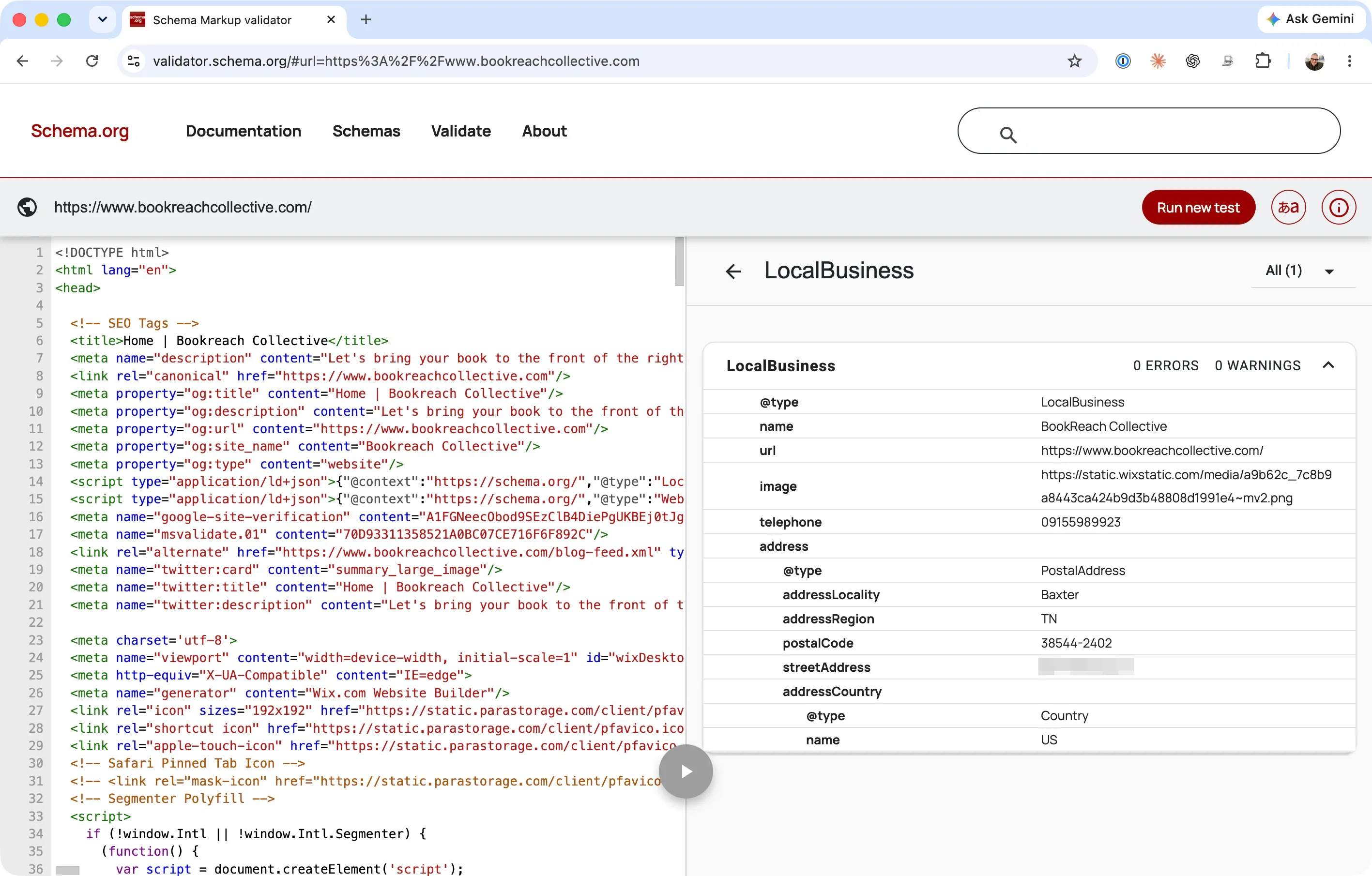
>>> Last update of WHOIS database: 2026-08-12T06:00:47Z <<<- The website’s structured data lists an address in Baxter, Tennessee 38544, USA, as its business address. Public property records describe that address as a single-family residence.
- I could not find named founders, staff biographies, a disclosed legal entity, client case studies, contractual terms, a refund policy or independent reviews under this exact business name.
- The site’s social icons linked to the generic homepages of the social networks rather than identifiable BookReach profiles.
- The site’s machine-readable business data listed a Tennessee residential address alongside a telephone number beginning
0915. Nigeria’s communications regulator assigns0915as a Nigerian mobile prefix. This inconsistency does not itself establish misconduct, but it requires an explanation. - The site published testimonials under the names Donna Tartt, Lenroe Rosewood and Diane Lil Adams without links to independently verifiable campaigns. I have not established whether those testimonials were authorised.
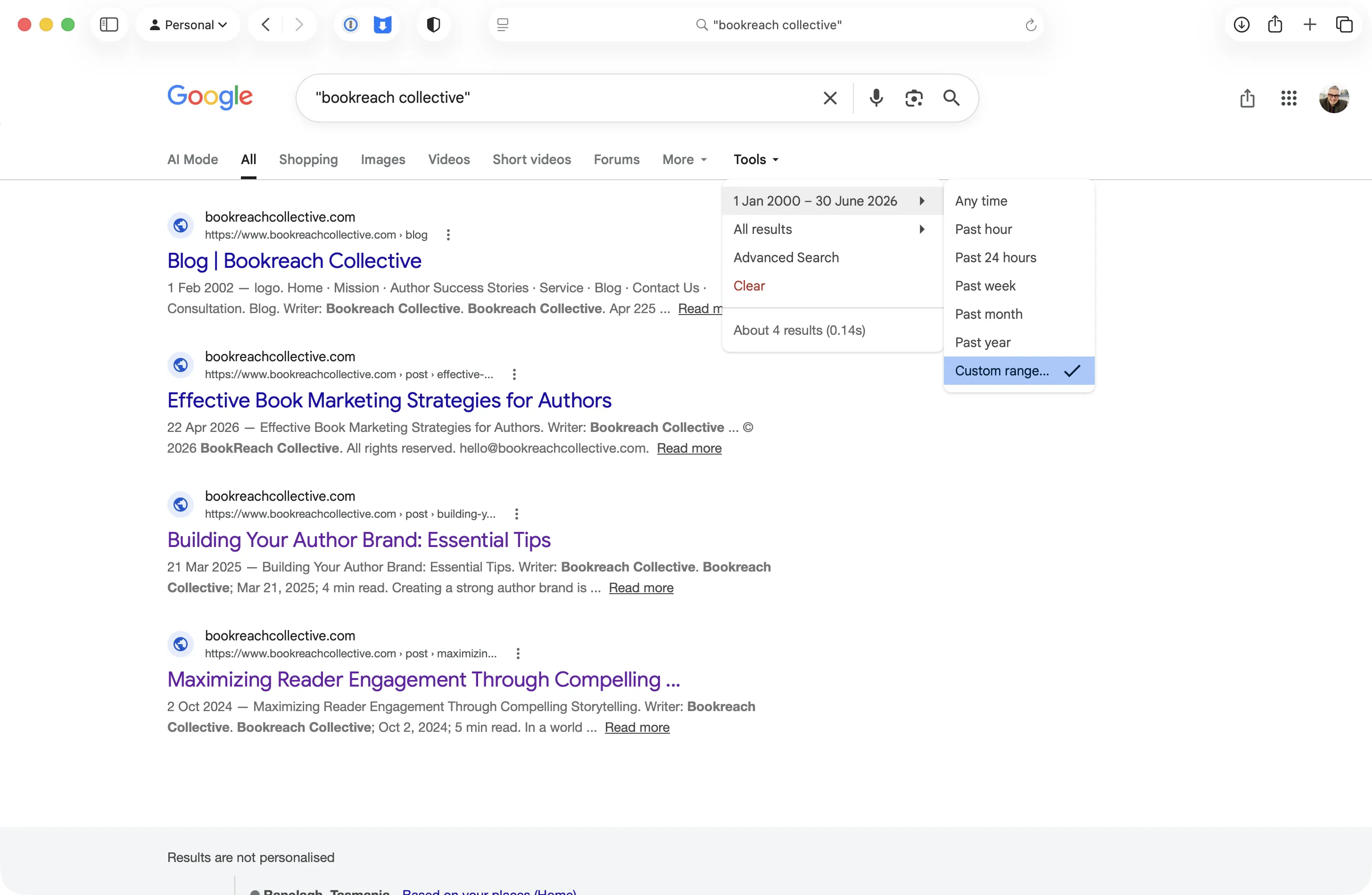
- In searches of Google’s index conducted on 12 August 2026, I found no mention of the exact name “BookReach Collective” before July 2026 other than the company’s own blog posts, which were dated earlier than the domain registration. The site displayed blog posts dated before the domain existed and website posts can be backdated, so those dates do not establish how long the business has operated.
Authors should recognise this pattern
The Authors Guild has warned about a sharp increase in approaches involving impersonated bestselling authors, book publicity and marketing services, free email accounts, unsolicited contact and AI-generated summaries of an author’s work. It notes that detailed knowledge of a book is no longer reliable proof of identity.
The pattern in this case was:
- Unsolicited, highly specific praise.
- Patient conversation rather than an immediate demand.
- Reassurance when scepticism was expressed.
- Personal questions and emotional encouragement.
- Introduction of a supposedly trusted service.
- Claims of exclusivity, friendship and fast-track access.
- A request for the unpublished manuscript.
- A substantial proposal framed as a referral discount.
- An initial deposit to begin immediately.
Marketing a book is hard
Most of the proposed tasks can be performed directly by an author. For example, Goodreads says its Author Program is free, and Amazon provides authors with instructions for creating A+ Content through KDP. That does not mean professional assistance with those tasks has no value. It does mean authors should demand a precise scope, accountable personnel, evidence of previous results, ownership of all accounts and assets, and clear contractual and refund terms before paying a substantial fee.
I recently built a new static website for Mark’s books using Astro and we host it on Cloudflare at no cost because of the small size of the website and its traffic. You can read more about what I built on my web developement website. We are preparing for the launch of his second book and making his books available for direct download without digital rights management so purchasers can load the books onto any ereader they prefer - we currently use Payhip and but would love to hear your recommendations.
Marketing any business in 2026 takes sustained work. IMHO engaging directly with an audience, either in person or through social networks, remains one of the most useful approaches for authors who do not already have a public profile or a large advertising budget.
I hate making content for social media as much as the next writer but it seems thats where the eyes and attention is.